


26 Jun WHY GREAT LEADERSHIP DEPENDS ON GREAT FOLLOWERSHIP
By Matt Johns MBE
Leadership isn’t just about the person at the front. Drawing on military leadership and Robert Kelley’s work on followership, Matt Johns explores why organisations that develop independent, engaged followers are better equipped to perform under pressure and navigate complexity.
The most important principles that have shaped my approach to leadership largely stem from my training and experience as an Army Officer. Two highly complementary theories that have proved consistently valuable through leading in a wide range of situations and at different organisational levels are those of Servant Leadership and Followership.
My focus here is on Followership, but it would be remiss not to mention it without covering at least part of Servant Leadership.
The role of Servant Leadership
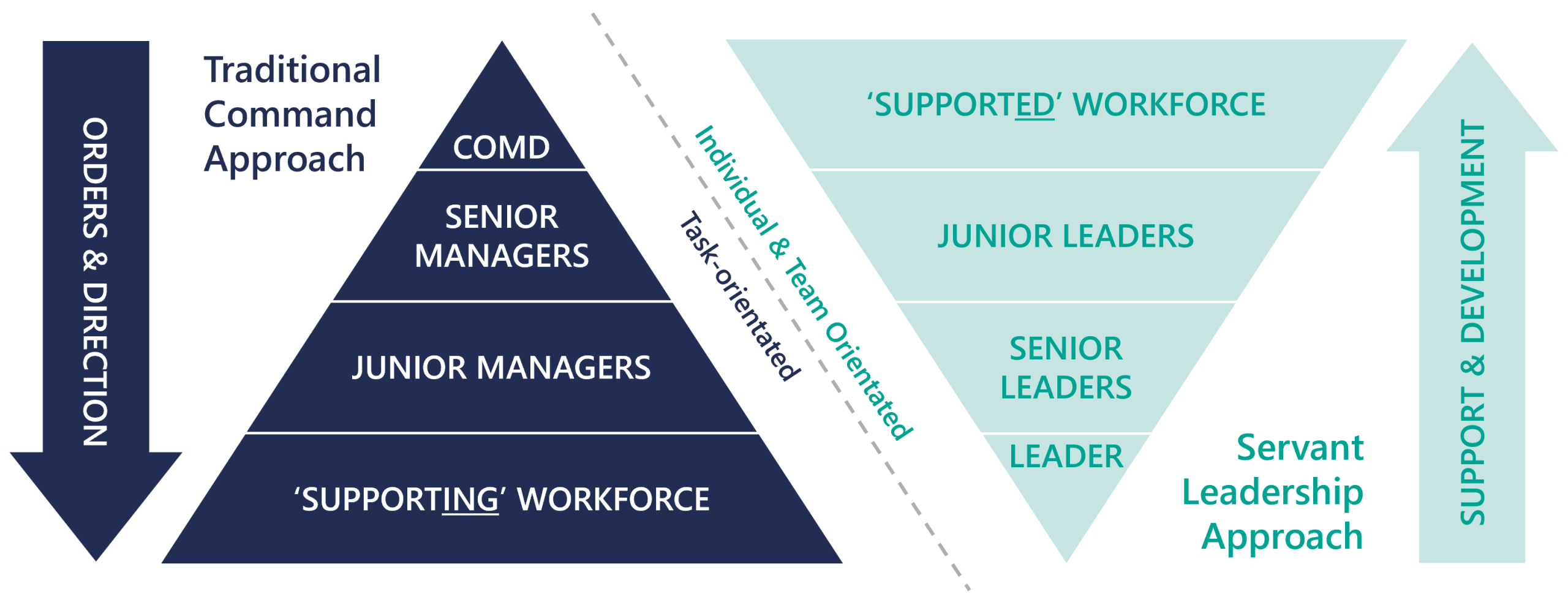
Servant Leadership is the ‘inverted pyramid’ of leadership with the workforce supporting the workforce and leaders at lower levels, rather than the more traditional leadership approach where the workforce is supporting the leader with the goals that need to be achieved. The focus is on the leader serving and empowering the workforce, and growing a high-performing team. The workforce is still committed to supporting and executing the leader’s vision, but with the power dynamic focusing on decentralised decision-making and coaching and mentoring the team to excel whilst also removing roadblocks.
It is highly suited to motivated and capable teams in complex environments. Much of the work on Servant Leadership stems from Robert Greenleaf’s 1970 essay on the topic, before later being expanded by the likes of Larry Spears and Dirk van Dierendonck. It has endured because it works, even more so as the complexity of work, and the educational level of the workforce in general continues to grow. In the age of AI, its significance can only grow further as the workforce increasingly will need to make decisions and analyse information at a rapidly growing scale.
The five types of followers
Followership sits neatly within the concept of Servant Leadership. Stemming from Robert Kelley’s initial work on the topic, Followership is concerned with how the workforce actively participates in the leadership process, and how the leader cannot thrive without effective followers. It also delves into how a leader’s behaviours influence how people choose to follow. If Servant Leadership is the what, Followership is the how.

- Exemplary (Effective) Followers: High in critical thinking and highly active. They complete tasks proactively, think independently, and constructively challenge leadership when necessary. A great read when it comes to considering effective followership is James Kerr’s ‘Legacy’, which looks at the successful All Blacks team culture. It emphasises the fact that effective followers don’t just follow, but take full ownership of ‘the mission’ and lead from where they stand. Effective followership requires a strong organisational culture of high trust, meritocracy and skilful leadership.
- Conformist Followers: High in engagement but low in critical thinking. Often called “yes people”, they aggressively support the leader but never question authority or offer alternative viewpoints. An important point here is that conformist followers don’t necessarily lack the ability to critically analyse, but choose not to because it offers no advantage to their position or status.
- Alienated Followers: High in critical thinking but low in engagement. They are independent thinkers who have become cynical or disgruntled, often pushing back against initiatives without offering constructive solutions. You will no doubt recognise this archetype from people in your own organisation. Those who may have great ideas or strong views, but lack the drive to do anything about them. This is often caused as much by leadership or organisational culture impeding motivation and agency as by key personality traits. Leadership failures, broken trust, organisational unfairness, past trauma and burnout are often the key contributory factors in creating an alienated workforce.
- Passive Followers: Low in both engagement and critical thinking. They require constant, direct supervision and only do the bare minimum requested of them. Usually the result of low motivation or a culture that demands compliance and sees independent thought as unnecessary or a threat. Authoritarianism and micromanagement are often the key root causes of passive followership. It can also be caused by a rife blame culture or over-bureaucracy where instigating change is frequently thwarted. Another contributory factor can be poor team selection where the workforce lacks skills or motivation for their role, a lack of investment in development, or poor incentivisation.
- Pragmatist Followers: Moderate in both dimensions. These “survivors” sit in the middle, doing whatever is necessary to keep their jobs and avoid controversy without taking political risks. Survivor behaviours are usually shaped by organisational instability, a stage of life or career where consistent drive is lacking, or highly politicised, often bureaucratic organisational cultures.
The leadership opportunity
The leaders that tend to inspire effective leadership behaviours often act as Servant Leaders – putting their people first, and coaching and mentoring them to succeed. They protect their workforce from some of the wider political or bureaucratic organisational landscape, and most importantly are able to engender trust and a feeling of stability.
The key takeaway – park the ego, put your people first, and invest your time in creating a team of effective followers, letting them play their part in achieving your goals.
Whatever organisational level, team size, or situation, leaders who consider followership as a route to operational success are likely to hold the upper hand, and have the benefit of leading effective, motivated and content teams.
Whilst Servant Leadership and Followership emerged in the 1970s, they are as relevant today, if not more so, than they have ever been as workforces and organisations evolve to operate in a world where AI allows workers at all levels to conduct critical analysis on a scale never seen before, and will need leaders to support and guide them as they make sense of this new landscape.
There’s something very motivating about solving problems and contributing meaningfully. As a leader, part of your role is to create the environment where that can happen.
Interested in building leaders and teams that perform under pressure?
Find out how Fieri helps organisations develop leadership capability that drives lasting performance